



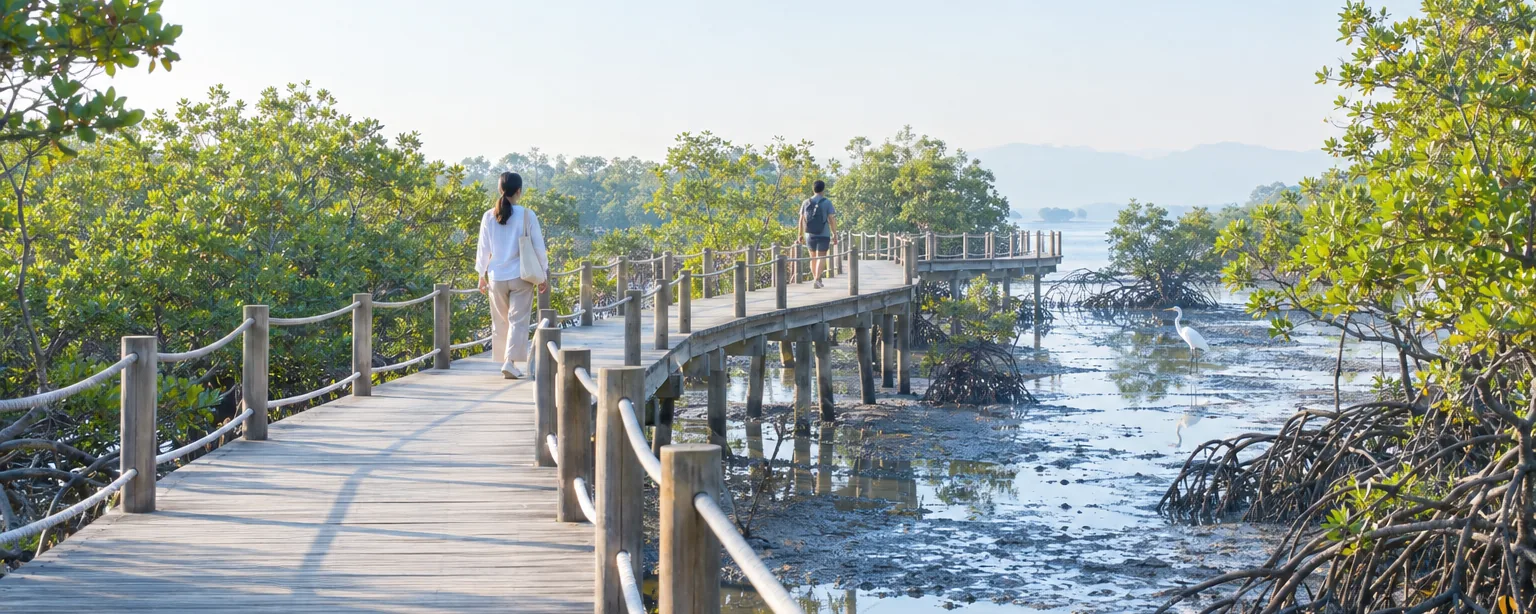
Summary completion: a passage on mangrove forests
You can complete a summary from a box of words, choosing each one by what the passage means.
Mangroves are trees that grow in salt water along tropical and subtropical coasts. The passage here is about them, and the task is a summary with gaps that you fill from a box of words.
The summary usually covers one part of the passage, and the box holds more words than there are gaps. Several words often fit a gap's grammar, so meaning decides.
Warm-up
Same idea, new word
Read the sentence, then the summary line. The word for the gap comes from a box.
Read thisFarmers in the valley have planted rows of trees between their fields, which stop the wind from blowing the soil away.
Summary: The trees help to protect the fields from soil ______.
How it works
Complete the summary using the list of words, A-J, below. Write the correct letter, A-J, in gaps 1-5.
- Aatmosphere
- Bdecay
- Cdrier
- Denergy
- Egrow
- Fhigher
- Gpredators
- Hsalt
- Istorms
- Jwater
Why mangrove forests matter
Mangrove roots slow down the water that flows through the forest, so waves lose much of their 1 before they reach the land. The roots also trap mud and sand, and over many years this can make the forest floor 2. Young fish, crabs and prawns shelter among the roots, where they are hidden from 3.
Because the mud of the forest floor contains so little oxygen, dead leaves and roots 4 very slowly, and the carbon in them stays in the ground. When a forest is cleared, however, this carbon may be released into the 5.
The other version of this task has no box. You copy words from the passage, within a word limit.
The method
- 1Find the part of the passage
Read the summary's title and first sentence, then find where the passage talks about the same thing. The answers may not follow the passage's order, but they usually come from one part of it.
- 2Decide what each gap needs
Look at the words on both sides. Much of their needs an uncountable noun. Make the forest floor needs an adjective. Dead leaves and roots needs a plural verb.
- 3Shortlist from the box
Usually only a few words in the box fit the grammar of a gap. Those are your candidates.
- 4Choose by meaning
Find the sentence the summary line comes from, and pick the candidate that says the same thing. It is often a different word: force in the passage, energy in the summary.
- 5Give the answer the task asks for
Here the instructions ask for the letter. Some words in the box are not used at all.
The passage
Forests at the edge of the sea
A Along many tropical and subtropical coasts, a strip of forest grows where it seems no forest could survive. Each day the tide comes in and covers the ground with salt water, and each day it goes out again, leaving soft mud behind. These are mangrove forests. The name does not refer to one kind of tree. It covers many species, some only distantly related, that have each found ways of living in salt water that would kill most plants.
B Salt is the first problem. Some mangroves stop most of it at their roots, which work like a very fine filter. Others take the salt in with the water and then push it out through their leaves, where it can sometimes be seen as small white crystals. The second problem is air. Roots need oxygen, and the wet mud contains almost none. Many mangroves solve this by sending up extra roots that stick out of the mud like pencils and take in air at low tide. Others stand on curved roots that lift the trunk above the water.
C These roots do more than keep the trees alive. As the tide flows in and out, the dense tangle of roots slows the water down. Waves arriving from the sea lose much of their force as they pass through the forest, so the land behind it is better protected from storms. The slower water also drops the mud and sand it was carrying, and the roots hold it in place. Over many years, this can raise the level of the forest floor.
D For wildlife, the forest is a nursery. Young fish, crabs and prawns hide among the roots, where the water is shallow and larger fish cannot easily follow. Many fish that are later caught at sea spend the first part of their lives here. The forests also store carbon. Dead leaves and roots end up in mud that has so little oxygen that they rot very slowly. As a result, the carbon they contain can stay buried for hundreds of years.
E In the late twentieth century, large areas of mangrove were cleared, mostly to make room for shrimp farms, rice fields and new building along the coast. When a forest is removed, the coast behind it loses its protection, and the carbon stored in the mud can be released into the air.
F Replanting seems the obvious answer, but a lot of early projects failed. Seedlings were often planted on open mudflats, where the tide covered them for too long each day, and large numbers of them died. Successful projects now tend to begin with the water. When the walls of old shrimp ponds are opened so that the tide can flow in and out again, mangrove seeds carried by the water often settle and grow without any planting at all.
Watch me do one
I'll do gap 3: where they are hidden from ______. After from I need a noun, something young animals hide from.
The sentence is about young fish, crabs and prawns, so I look for them in the passage. They are in paragraph D.
D says they hide among the roots, where the water is shallow and larger fish cannot easily follow.
Several nouns in the box fit after from, but only two make sense for young fish: storms and predators. Storms is in the passage, which makes it feel safe.
But storms are in paragraph C, and there it is the land behind the forest that is protected from them.
Larger fish cannot easily follow means animals that would eat the young ones. That is what predators means, so I write G.
Practice with Elita5 questions
First, where the summary comes from. Then the four gaps I left for you.
Where the summary comes from
Read the summary's title and first sentence again. Then decide which part of the passage it covers.
Which paragraphs does the summary come from?
Gap 1
Read paragraph C and choose the word for gap 1.
Read thisThese roots do more than keep the trees alive. As the tide flows in and out, the dense tangle of roots slows the water down. Waves arriving from the sea lose much of their force as they pass through the forest, so the land behind it is better protected from storms. The slower water also drops the mud and sand it was carrying, and the roots hold it in place. Over many years, this can raise the level of the forest floor.
Mangrove roots slow down the water that flows through the forest, so waves lose much of their ______ before they reach the land.
Gap 2
Stay with paragraph C. Choose the word for gap 2.
Read thisThese roots do more than keep the trees alive. As the tide flows in and out, the dense tangle of roots slows the water down. Waves arriving from the sea lose much of their force as they pass through the forest, so the land behind it is better protected from storms. The slower water also drops the mud and sand it was carrying, and the roots hold it in place. Over many years, this can raise the level of the forest floor.
The roots also trap mud and sand, and over many years this can make the forest floor ______.
Gap 4
Read paragraph D and choose the word for gap 4.
Read thisFor wildlife, the forest is a nursery. Young fish, crabs and prawns hide among the roots, where the water is shallow and larger fish cannot easily follow. Many fish that are later caught at sea spend the first part of their lives here. The forests also store carbon. Dead leaves and roots end up in mud that has so little oxygen that they rot very slowly. As a result, the carbon they contain can stay buried for hundreds of years.
Because the mud of the forest floor contains so little oxygen, dead leaves and roots ______ very slowly, and the carbon in them stays in the ground.
Gap 5
Read paragraph E and choose the word for the last gap.
Read thisIn the late twentieth century, large areas of mangrove were cleared, mostly to make room for shrimp farms, rice fields and new building along the coast. When a forest is removed, the coast behind it loses its protection, and the carbon stored in the mud can be released into the air.
When a forest is cleared, however, this carbon may be released into the ______.
Words to keep
The regular rise and fall of the sea. At high tide, the mangrove roots are under water.
A mass of things twisted together. Young fish hide in the tangle of roots.
Stay somewhere safe from danger or bad weather. Young crabs shelter among the roots, where larger fish cannot follow them.
Break down slowly after dying; rot. Leaves decay slowly in mud that has little oxygen.
Remove the trees and plants from an area. Large areas of mangrove were cleared for shrimp farms.
A very young plant grown from a seed. Seedlings planted on open mudflats often died.
Let something out. Clearing a forest can release carbon into the air.
Before you go
Find the part of the passage the summary covers before you look closely at the box.
Use the words around each gap to decide what kind of word fits, and shortlist from the box.
Choose by meaning. The right word often says the passage's idea in a different word.
Check any box word you recognise from the passage: it may be there, but about something else.
Next: The listening lesson is next: a lecture on how seed banks keep seeds alive, with a set of notes to complete.