



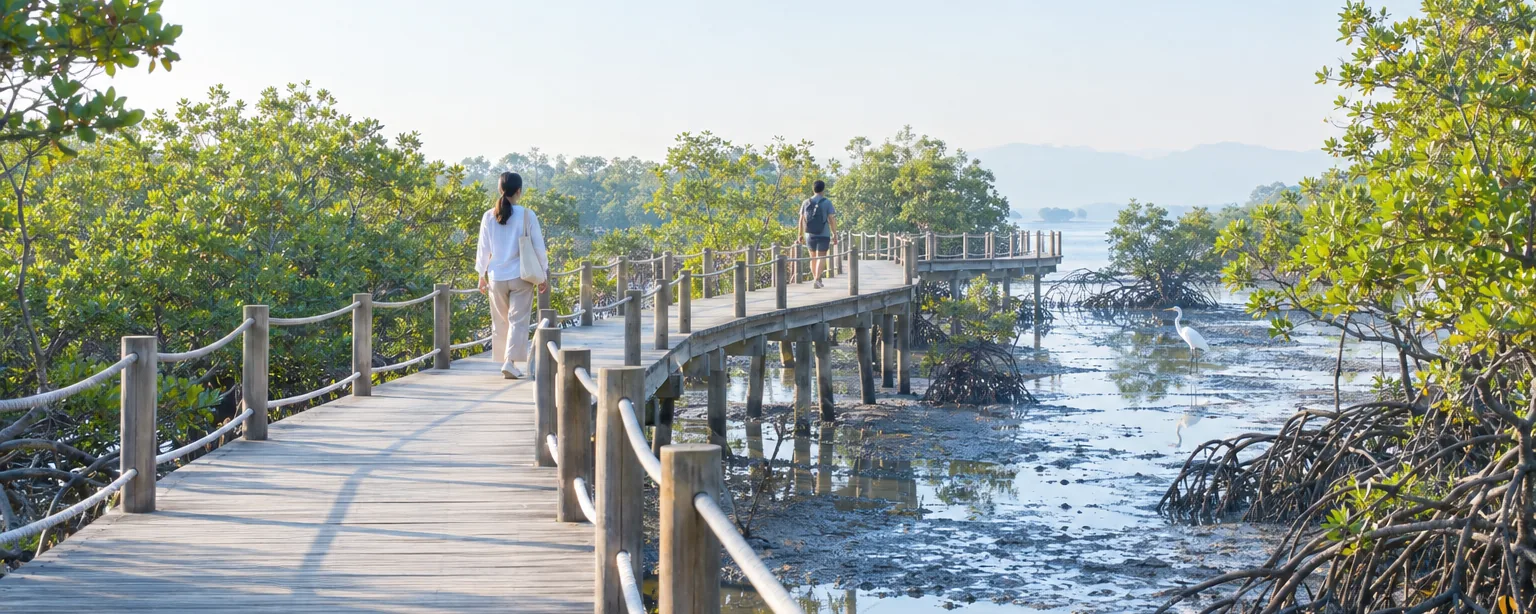
Part 2: describing a natural place you enjoy
You can describe a place so the examiner can picture it, and fill two minutes without running out of things to say.
The examiner hands you a card with a topic, a pencil and some paper. You have one minute to make notes, and then you talk for up to two minutes.
A place in nature is easy to start and hard to fill. Once you have said where it is and that it is beautiful, there is little left. Below are four kinds of detail that fill the time, and a model talk that uses them.
Warm-up
Can you see it?
Three candidates describe the same kind of place. Which sentence gives the examiner a picture?
Which sentence helps the examiner picture the place?
How it works
Now I'm going to give you a topic and I'd like you to talk about it for one to two minutes. Before you talk, you'll have one minute to think about what you're going to say. You can make some notes if you wish.
Describe a place in nature that you enjoy going to.
You should say:
- where it is
- how you get there
- what you can see and hear there
and explain why you enjoy going there.
You get one minute to prepare, with a pencil and paper for notes. The examiner may ask one or two questions when you finish.
Four things to note in your minute
- 1Where it is, and how you get there
A few words for each. These open the talk and answer the first two points on the card.
- 2Two things you see and one you hear
Sounds are the detail most people forget, and they make a place feel real to the listener.
- 3One visit
A particular time you went, and what happened. Told in the past tense, it fills the middle of the talk and shows a second set of verb forms.
- 4Two reasons
For the explain line. Keep the stronger one for last and give it time, because this is where the talk becomes about you.
Two minutes, roughly
- 15 sec: Where it is
- 15 sec: Getting there
- 35 sec: What you see and hear
- 25 sec: One visit
- 30 sec: Why you go
Total: 120 sec
Telling and showing
It's a really beautiful and peaceful place, with nice scenery.
Early in the morning the water's completely still, and you can see the hills upside down in it.
Watch me do one
I'll use my minute on the card above. Say my place is a reservoir in the hills behind my home town.
Where and how: top reservoir, hills; bus to last stop, steep road, 20 min. That covers the first two points.
See and hear: still water, hills reflected; birds, wind, no traffic. The quiet is what I notice most, so it goes in.
One visit: week before exams, walked round twice, no phone.
Why: close to town but feels separate; where I think clearly. The second reason is stronger, so I'll end with it.
Those are all notes. In the minute I write things I can talk about, and I never write full sentences.
A model answer
Describe a place in nature that you enjoy going to.
The place I'd like to talk about is a reservoir in the hills behind the town where I grew up. It doesn't have a proper name. Everyone just calls it the top reservoir. Getting there takes a bit of effort. You take a bus to the last stop, then walk up a steep road for about twenty minutes. It's hard work in summer, but the road goes through trees, so at least you're in the shade most of the way. Then, right at the top, the view opens up all at once. The water's very still, especially early in the morning, and you can see the hills reflected in it, almost like a mirror. There's a path that goes right round the edge. What I notice most, though, is the sound, or really the lack of it. You hear birds, and sometimes the wind in the trees, and that's about it. No traffic at all. I remember going up there the week before my final exams at school. I was really stressed, and I walked round the whole reservoir twice without looking at my phone once. By the time I got back to the bus stop, I felt like a different person. So why do I enjoy it? Partly because it's so close to the town but feels completely separate from it. And partly because it's where I go when I need to think clearly. I've made quite a few big decisions on that path, actually.
- CoherenceThe place is named in the first sentence, so the examiner knows what the talk is about.
- VocabularyA natural phrase for arriving somewhere with a wide view.
- VocabularyA picture the examiner can see. Beautiful would not give one.
- TaskCovers what you can hear, and makes the quiet itself the detail.
- CoherenceOne visit, told as a short story, carries the middle of the talk.
- GrammarA time clause in the past, used accurately while telling a story.
- GrammarThe present perfect for experience up to now, in a natural closing line.
Coloured text shows what the examiner is looking for.
Practice with Elita6 questions
Four quick questions on the method, then two recordings for me to listen to.
The first sentence
You have your notes. Choose the best way to begin the talk.
Which opening is best?
Which point?
Which point on the card does this sentence answer?
You can hear the waves pulling the small stones back down the beach.
A reason you can believe
The card says explain why you enjoy going there. Which answer gives the strongest reason?
Which is the strongest reason?
A visit, told in the past
One sentence in this part of a talk has a tense mistake. Choose it.
Which sentence contains the error?
Record: your reasons
Answer the explain line only, in about thirty seconds. Give two reasons and end with the stronger one.
Explain why you enjoy going to your place in nature.
Record your answer (45s maximum)
0:00 / 0:45
Set up your learning path at the top of this lesson to get band-specific feedback.
Record: the whole talk
Take one minute to make notes on the card, then talk for up to two minutes.
Describe a place in nature that you enjoy going to. You should say where it is, how you get there, what you can see and hear there, and explain why you enjoy going there.
Record your answer (120s maximum)
0:00 / 2:00
Set up your learning path at the top of this lesson to get band-specific feedback.
Words to keep
Going up or down sharply. The road up to the reservoir is steep.
Out of direct sunlight. Most of the path is in the shade of tall trees.
You suddenly see a wide area in front of you. At the top of the hill, the view opens up.
Seen as an image on water or glass. The hills are reflected in the still water.
All the way round. A path goes right round the lake.
Feel much calmer or happier than before. After a walk by the sea, I feel like a different person.
Before you go
Name the place in your first sentence.
Show it with what you see and hear, in details only you would know.
Tell one visit as a short story, in the past tense.
Keep your best reason for the explain line, and give it time.
Next: Then comes Task 2: an essay on plastic in rivers and on beaches, covering the problems it causes and what could be done.